Simcha Fisher: “The last things my parents read”

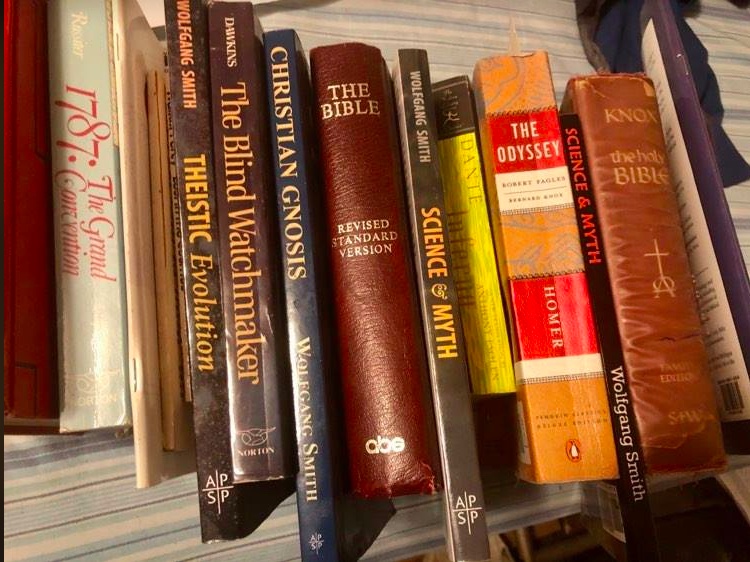
This post is to point you over here to Simcha Fisher’s creative blog post documenting the last books her parents read before they died.

Thanks to my friend Natalie for thinking to share this post with me.

The way in which Simcha takes note of her parents’ last reads or, at least, the books that adorned and surrounded their bedside tables attests to the way in which a personal library is a reflection of a person’s soul.

This reminds me of Anne Fadiman’s splendid chapter on “Marrying Libraries” in her book Ex Libris in which she reflects amusingly, “After five years of marriage and a child, George and I finally resolved that we were ready for the more profound intimacy of library consolidation.”

I am also reminded of Fr. James V. Schall’s insistence on the importance or building a personal library.

He says:

When we move or build, we should look for places to keep our collected books and printed matter. Read books are a precious item. No one else will ever read a book quite the same way that we do. Books can speak in many different ways, even at different times in our own lives. I always assign what I consider fine and great books to my students, books that are worth reading again and again. I would be ashamed to assign to a student a book that I did not think worth keeping. I have myself read Aristotle and Plato and Aquinas and Chesterton many, many times—finding something new in each reading. Furthermore, at different times of my life, I have seen things in these works that I could not have seen when I was younger.

Thus, I conceive a personal library to be composed of books we have read again. I consider a book that we have read to be part of our memory, something we can quickly go back to, something we can look at again when a problem or controversy arises. Often we know that we have read the precise argument we need.

In this personal library of ours, as I have explained, we ought to have books that we have read, though there is nothing wrong with accumulating in advance books we might never read or read only years later. No serious book-lover will ever die having read every book he has managed to collect. This is not a sign of dilatoriness but of eagerness, anticipation. I do not mean here the technical books of a given discipline that quickly become out-of-date, though even these preserve a certain history. Rather, I mean those books which explain things, that touch on the truths of our being, that reach to what is.

As Simcha’s post shows, a personal library is not merely an individual possession; it can also be a remnant of a person’s values, quest, and character.
Intimations of the resurrection of the dead

Have you stopped at any point during the pandemic to take note – and perhaps even photos – of the deserted streets? Maybe you noticed that you were the only person on the entire bus during rush hour. Or maybe you noticed the gradually shuttered businesses. Maybe you noticed the empty schoolyards and office buildings.

The extent to which you took notice of the dramatic emptiness is likely to correspond to the extent to which you are likely to revel in the return to life. After all, there was never a “new normal”, but only something very abnormal.

I have thought for some time that reuniting with friends (and heck, even with strangers) after the pandemic will feel a bit like a foretaste of the resurrection of the dead. After all, if anything can help our imagination of the phenomenon, it seems to me to be this experience of acute absence, separation, and isolation that will next be countered with intense presence, reunion, and togetherness.

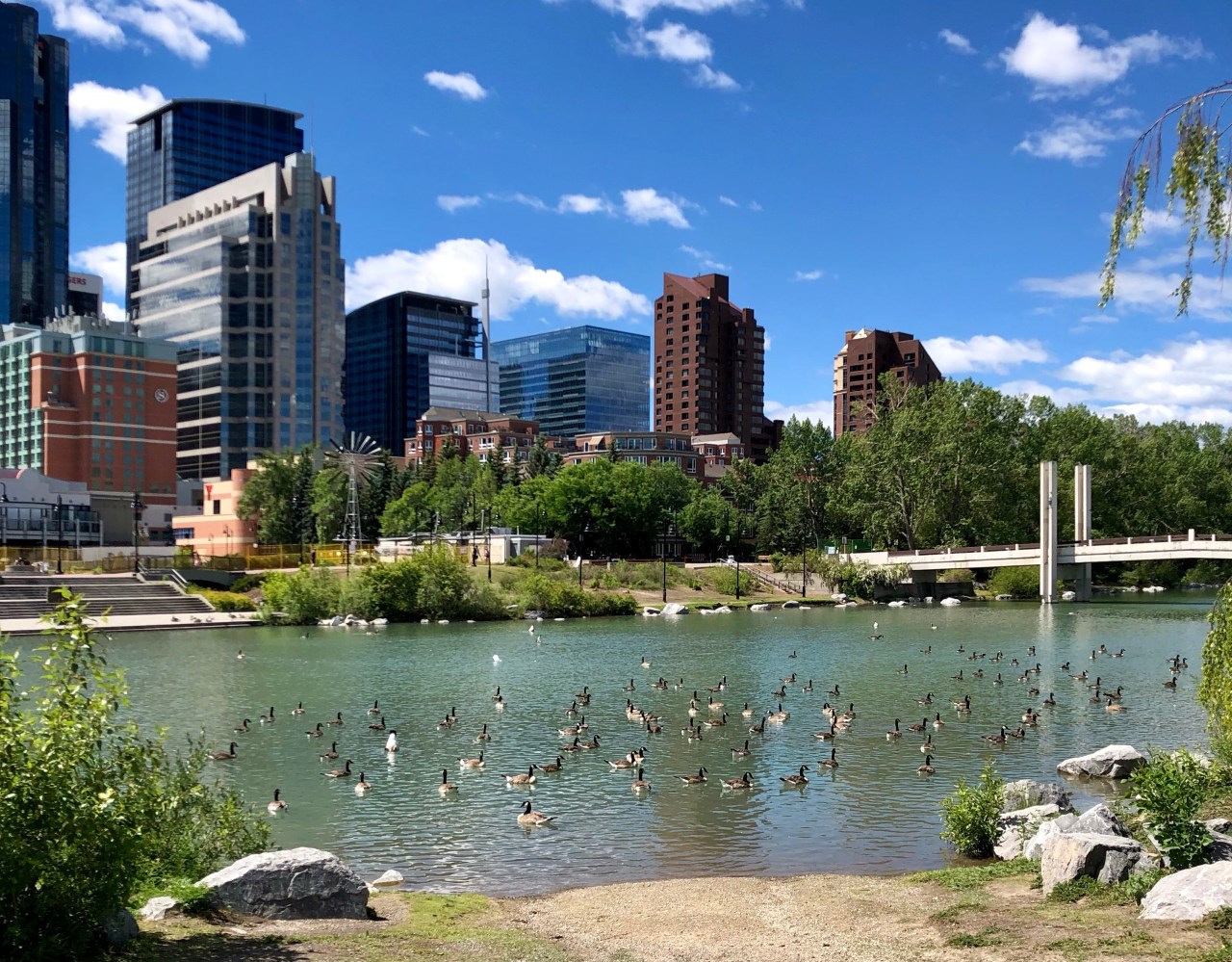
Today I was in my hometown revelling in the return to life of people, businesses, worship, and optimism. As I walked through Prince’s Island Park, down Stephen’s Avenue, and along 17th Avenue, I marvelled at people – real human beings with flesh and bones associating with only the occassionally mediating plexiglass divider along the patios.

Today, in my hometown, I also visited the cathedral and, unexpectedly, saw three people who were great a surprise to see. Seeing these people who were so pivotal in my early life all in one place and after all these years also felt like a foretaste of the resurrection of the dead. There was something timeless about it.

The resurrection of the dead, an essential belief in Judaism and Christianity, is full of mystery. Still, I like to think we can enjoy intimations of it in everyday life, and perhaps particularly in the return to life from lockdowns and travel restrictions.

Recipes for remembrance

In families, people become known for certain recipes that they perfect and make their own by a certain flair.

This creates a connection between the particular food and the love of the cook for their family and friends.

When the dishes reappear annually on holidays and special occasions, the indispensability of those foods is a symbol for the indispensability of the person.

Without certain dishes, the table would seem as incomplete as it would if family members were delayed or absent.

My mother showed me this cookbook (pictured) that belonged to my paternal grandmother. About it she said, “It’s a real connection to your grandmother’s love for our family. She embellished it with many recipes she received from her own friends over the years and handwrote inside, making it a one-of-kind book that could not simply be re-purchased or replaced.”

In fact, after my grandmother died, my mother used the flourishes in this cookbook to inform the dishes she prepared for my grandfather. Of course, being served the same foods his wife had lovingly prepared during their sixty-eight years of marriage was a great blessing and consolation for him.

Recipes passed through generations can season life with the flavours of those who came before us.

“May the wolf die!”

Today I learned an Italian idiom for wishing someone good luck that struck me as rather intriguing.

The phrase In bocca al lupo literally means “into the wolf’s mouth.”

The common reply on being wished good luck in this way is crepi il lupo – may the wolf die, or simply Crepi! meaning “May it die!”

The superstition embedded in such idiomatic phrases is that it is bad luck to wish someone good luck directly.

It is amusing to consider the ways in which presuming the worst can be a way of actually hoping for the best.

The Italian who taught me this idiom said that this mentality is quite deeply embedded in the culture. For example, before going rock climbing with some of his Mexican friends recently, he suggested to them that they would all be in the news after the trip having fallen off of the cliffs to their deaths.

Continue reading

Longevity of Renown

This evening I am reflecting on two famous Italians who died on this date – one is Niccolò Machiavelli who died in 1527 and the other is Aloysius de Gonzaga, S.J. who died in 1591. The latter lived fewer than half as many years than the former. And, while Machiavelli is certainly on more course syllabi today, Aloysius de Gonzaga is a canonized saint whose example and spirit continues to be invoked from generation to generation.

Aloysius de Gonzaga came from an affluent and influential family. He decided, however, to renounce his aristocratic lifestyle and joined the Jesuits while he was still a teenager. When there was a plague in Rome in 1591, Aloysius insisted on volunteering at a hospital and it was in this context that he contracted the disease and died when he was just 23.

What does a 23-year-old who died in the sixteenth century have to teach young people today living in the 21st century?

Here is a summary of Pope Francis’ remarks on this point to high schoolers:

Continue reading

Not Wholly Gone

This Father’s Day, I have noticed many people acknowledging the ongoing influence of fathers, grandfathers, and other father figures in their lives – even after these men have died.

It is interesting to consider the ways in which, through memory and legacy, a person can continue to be a part of a family even after death.

This evening, my mother shared an anecdote with me to this effect about my paternal grandfather.

My paternal grandfather was Polish and he died in 2015.

Continue reading

“Why hasn’t God taken me home yet?”

This evening my friend who is a doctor shared with me an anecdote from the past week.

She had a 90-year-old patient named Laurence who was admitted for recurrent falls and who may not be able to return to independent living in her own home because she lives alone.

Laurence never married and does not have any children, but her nieces and nephews help her out with cooking, shopping, and managing her finances and appointments.

During the hospitalization, my friend had a few conversations with Laurence and, many times, she would ask, “Why hasn’t God taken me home yet? I’m 90-years-old now. I’m sure I will go to heaven, and I don’t know what else to do here.”

My friend noted that Laurence had mentioned on a few occasions that one of her defects is impatience.

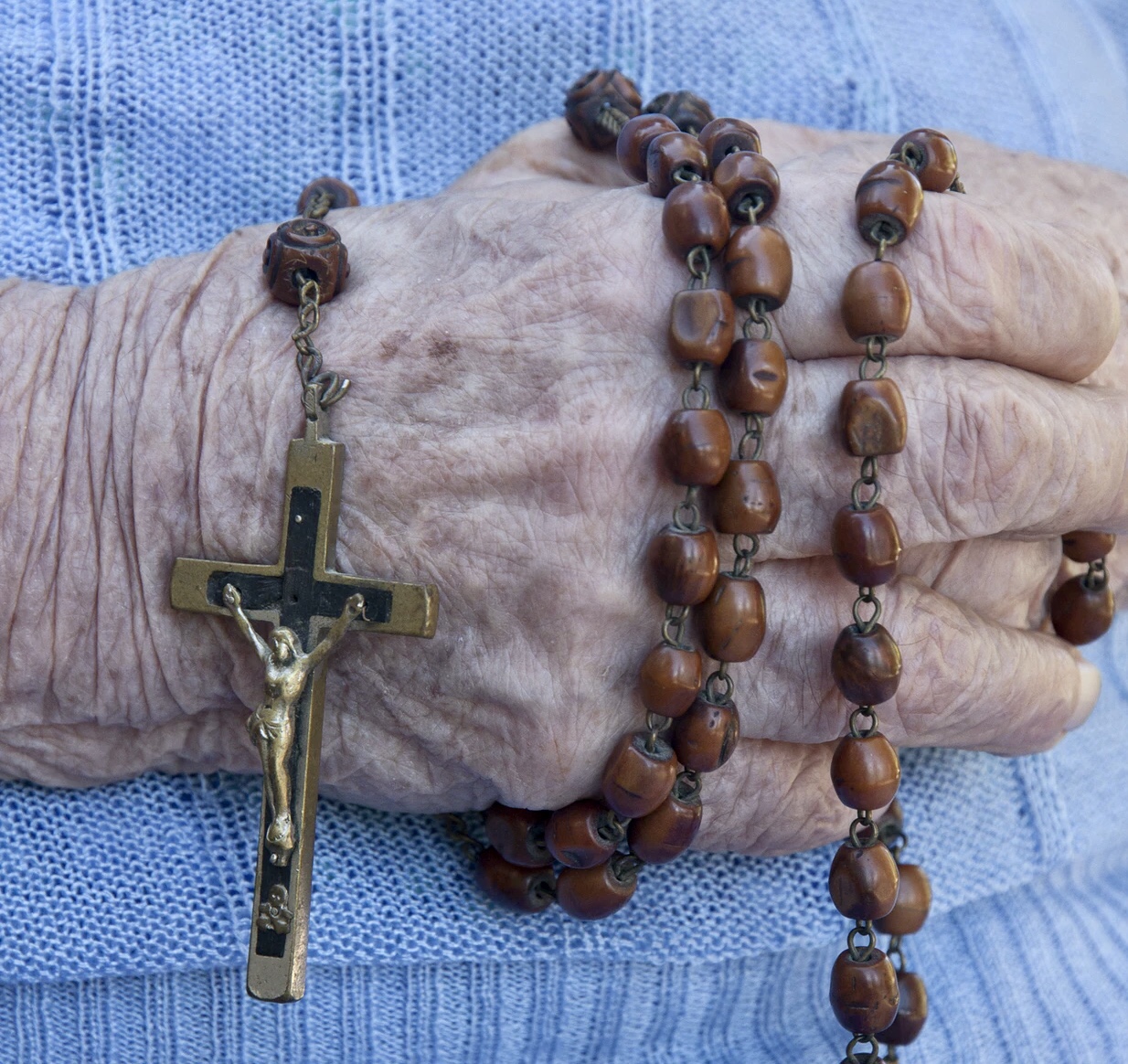
“All I do every day is pray the rosary again and again,” Laurence said.

My friend thought quickly about how to help Laurence to see the value in her continued days.

“Maybe God is not taking you home just yet, because there’s something in which you’re meant to still grow – your patience.”

She gave a smile of compliant recognition and replied, “Yeah, maybe.”

Later that afternoon, as Laurence was leaving the unit to be transferred to another hospital, she said goodbye to my friend and said, “I know what my mission is now – to work on my patience!”

What a beautiful encounter of helping another to discover a new mission, even in her old age.

Hope is death’s counterweight

This evening I was reading some of the poetry of Karol Wojtyła and came across a poem called “Hope Reaching Beyond the Limit.”

Take a look at these excerpted lines:

Hope rises in time
from all places subject to death—
hope is its counterweight.
The dying world unveils its life again
in hope.

[…]

But death is the experience of the limit,
it has something of annihilation,
I use hope to detach my own self,
I must tear myself away
to stand above annihilation.
And then from all sides they call and will call out:
“You are mad, Paul, you are mad.” [Acts 26:24]
I wrestle with myself,
with so many others I wrestle for my hope.

We need to exercise our disposition to hope.

Looking forward to the future.
Seeing the possibility of new generations.
Delighting in the glorious unpredictability of human affairs.

Otherwise, the limits of this life can “annihilate” our spirit.

What do you do to stand beyond the limits?

What do you do to wrestle for your hope?

“Without the day of the Lord, we cannot live.”

In his splendid essay “On the Meaning of Sunday,” Joseph Ratzinger wrote about how the early Christians would say, “Without the day of the Lord, we cannot live.”

Take a look at how he describes this existential priority and what it means in the lives of those who hold to it:

“Without the day of the Lord, we cannot live.” This is not a labored obedience to an ecclesiastical prescription considered as some external precept, but is instead the expression of an interior duty and, at the same time, of a personal decision. It refers to that which has become the supporting nucleus of one’s existence, of one’s entire being, and it documents what has become so important as to need to be fulfilled even in the case of danger of death, imparting as it does a real assurance and internal freedom. To those who so expressed themselves, it would have seemed manifestly absurd to guarantee survival and external tranquility for themselves at the price of the renunciation of this vital ground. […] For them it was not a question of a choice between one precept and another, but rather of a choice between all that gave meaning and consistency to life and a life devoid of meaning.

I often think about this passage when reflecting on contemporary Christians who risk their lives to go to church in countries where there is severe persecution and repression.

There is indeed something luminous in the witness of those who would risk their lives to affirm the values that make life altogether precious in the first place.

It is a profound and potentially orienting question to contemplate: What is it in our lives without which our survival has no value?

Photo: Maronite Church in Kfar Baram in northern Israel in summer 2017

A Graduation Speech About Deathbed Reflections

This is a really short post to direct you to this excellent commencement address delivered by Ryan T. Anderson.

He titled it, “‘He Knows What He Is About’: Living a Life That Matters”, which is derived from one of the most splendid quotations of John Henry Newman that Dr. Anderson quotes at the outset and on which my friends and I have been reflecting a lot in recent days.

Particularly of relevance to the theme of this blog, I was struck by how Dr. Anderson exhorted the high schoolers on multiple occasions throughout the address to contemplate the thoughts they might have on their deathbeds as a key to discerning how to live a life that matters.

Below are three short excerpts:

Continue reading