This evening my friend shared a story with me about a couple she knows.
The couple is in their 80s and both the husband and wife are undergoing the loss of their memory.
This couple has been married for more than sixty years and they have three adult children.
One son and one daughter, who each have families of their own, have been committed to caring for their aging parents in the home in which they had all spent their life together as the children were being raised.
In an effort to preserve the routine and normalcy of family life, and in order to avoid needing to put the parents into a long-term care home, the adult son and daughter have developed a ritual of care.
Every single day, for the past six years, the daughter arrives to the home at 11:00 a.m. to serve her parents lunch.
And every single day, for the same six years, the son has arrived at 5:00 p.m. to serve dinner to his parents and then to open the door to the personal support workers who then take over in assisting with the parents’ care into the evening.

Deeds
Doing away with superstitions
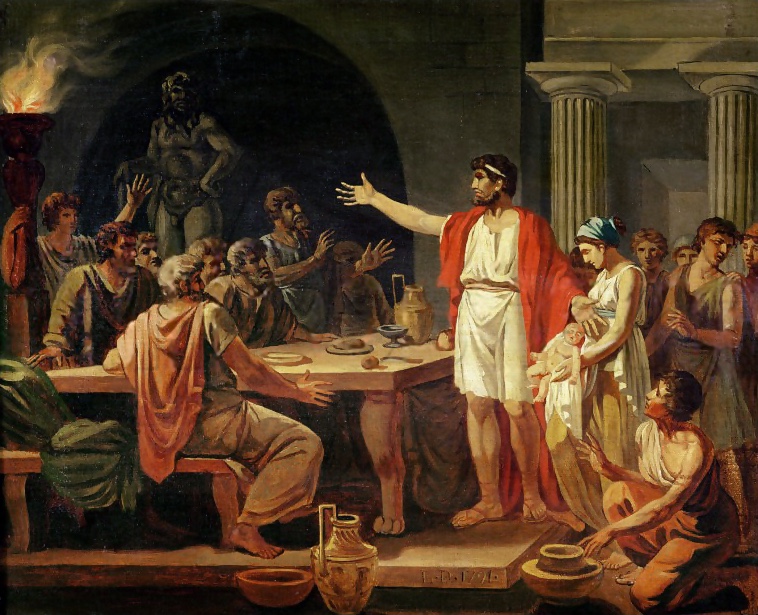
One of my favourite classical texts is Plutarch’s Parallel Lives. In writing about the lives of noble Greeks and Romans, Plutarch said his intention was not so much to write history as to write edifying moral biographies.
He said, “For I do not write Histories, but Lives; nor do the most conspicuous acts of necessity exhibit a man’s virtue or his vice, but oftentimes some slight circumstance, a word, or a jest, shows a man’s character better than battles with the slaughter of tens of thousands, and the greatest arrays of armies and sieges of cities. Now, as painters produce a likeness by a representation of the countenance and the expression of the eyes, without troubling themselves about the other parts of the body, so I must be allowed to look rather into the signs of a man’s character, and thus give a portrait of his life, leaving others to describe great events and battles.”
In introducing the life of Lycurgus, Plutarch even admits, “Concerning Lycurgus the lawgiver, in general, nothing can be said which is not disputed, since indeed there are different accounts of his birth, his travels, his death, and above all, of his work as lawmaker and statesman.”
Nevertheless, he has much to say about Lycurgus and his efforts “to make his people free-minded, self-sufficing, and moderate in all their ways.”
One section that I found particularly interesting is about burial. Here’s what Plutarch tells us:
Rabbi Bulka is a Role Model in How to Suffer
It would be understandable if, upon receiving a cancer diagnosis, a person were to retreat, to withdraw.
But that’s not Rabbi Dr. Reuven Bulka’s way. Instead, as ever, he continues to show leadership, to give example, and, above all, to generously go outside of himself for the good of others.
It seems that every time there is a tragedy or crisis, particularly in which his community or he himself is implicated, Rabbi Bulka has something to say with humility, sincerity, and gratitude.
Continue reading