Once, when I was a student in Poland, I was living in a dormitory taken care of by Ursuline sisters.
It was a Wednesday morning on November 2nd when I came downstairs to do my laundry.
The kind ginger sister, a young Catholic from Russia, Sister Maria, took pity on me but the elderly Sister Elisabeth at her side at reception was clearly dismayed at the need to make an exception. I approached the reception window at the entrance lobby of my dormitory with a plastic bag, full of dirty laundry, my bottle of detergent, my ID card to exchange for the laundry room key and five złoty in change to receive a special coin to activate the washing machine.
They both looked at me with a look that said, “Shouldn’t you know better?” But, in truth, I didn’t know better.
“Today is a holiday,” Sister Maria stated, alluding to All Souls’ Day.
Some reflections from the Poland years (2015-2017):
“There was a cross in every direction. And there weren’t just four directions, like now.” – Wiesław Myśliwski, Stone Upon Stone
In the lead up to All Saints’ Day, there were dozens of people selling candles and flowers at each of the entrances leading into the Lipowa cemetery. It was easy to notice this happening, because this cemetery is right next to the main mall in the city. This reminded me of how Plutarch had praised the Spartan Lycurgus for doing away with superstitions by allowing citizens to bury their dead within the city which, he said, had the effect of making the youth familiar with such sights so that they were neither confounded by death nor fearful of it.
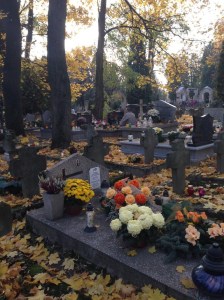
In these days, I observed all of the flowers and candles being placed on the graves in anticipation of the feast days – seeing sisters in their habits scrubbing the graves of the members of their communities who had gone before them, and men raking the leaves between the tombs, and students and graduates decorating with flowers and candles and rosaries the graves of the university’s founder and first rector, Rev. Idzi Radziszewski as well as that of Mieczysław Albert Maria Krąpiec OP, the founder of the Lublin Philosophical School – who struck me as among the cemeterary’s leading protagonists.
On All Saints’ Day, my friends and I went again to this cemetery. As we walked, we passed many others who were visiting, walking slowly and reverently. Has anyone ever run through a cemetery, anyway? The setting seems to slow you down, as if to teach that rushing through life will only bring you more quickly to your grave.
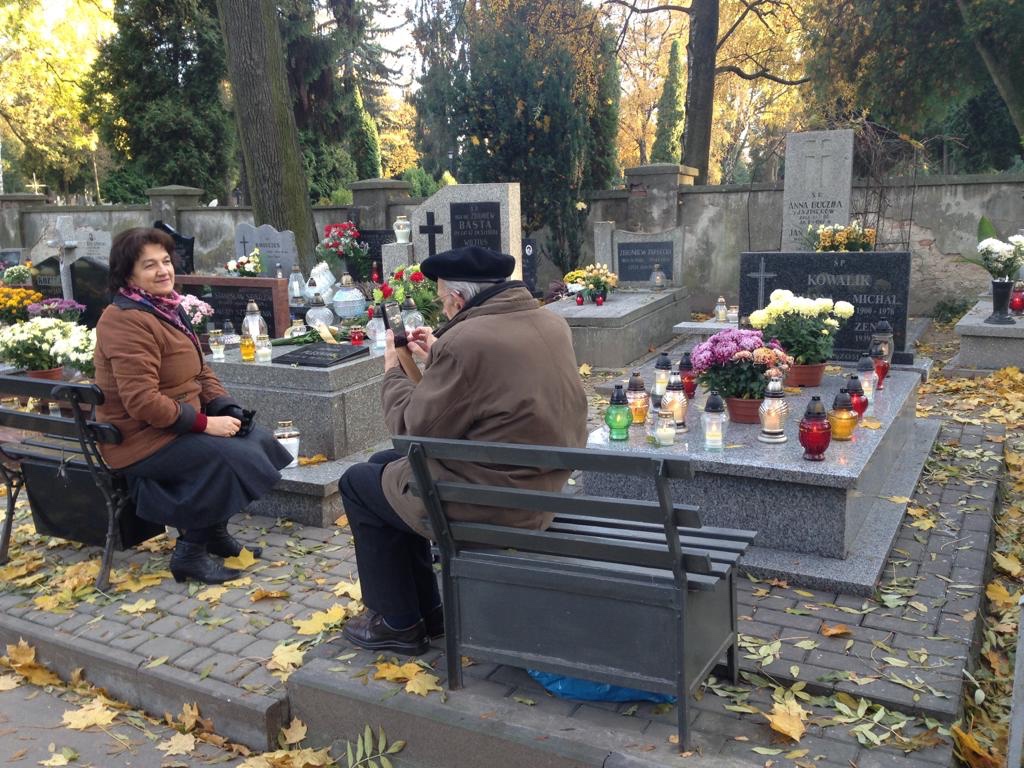
I saw a young man holding his grandmother’s arm to assist her. I saw a father carrying his young daughter on his shoulders. I saw an elderly couple sitting across from one another on benches before the graves – the husband taking a photo of his wife on a smartphone. I saw a boy in a wheelchair, staring at a grave with his family surrounding him. And I saw small children playing and smiling, hoping to get a candle or bouquet to place upon a grave or to contribute as part of a larger memorial. This is the most life I have ever witnessed in a cemetery, I marvelled to myself. It is also the most human cemetery I have seen. I glanced at the Latin inscription – Non omnis moriar – not all of me will die, or, I shall not wholly die. And I also thought to myself – not all is death. Among the dead, the living walk, play, talk, laugh, and visit.
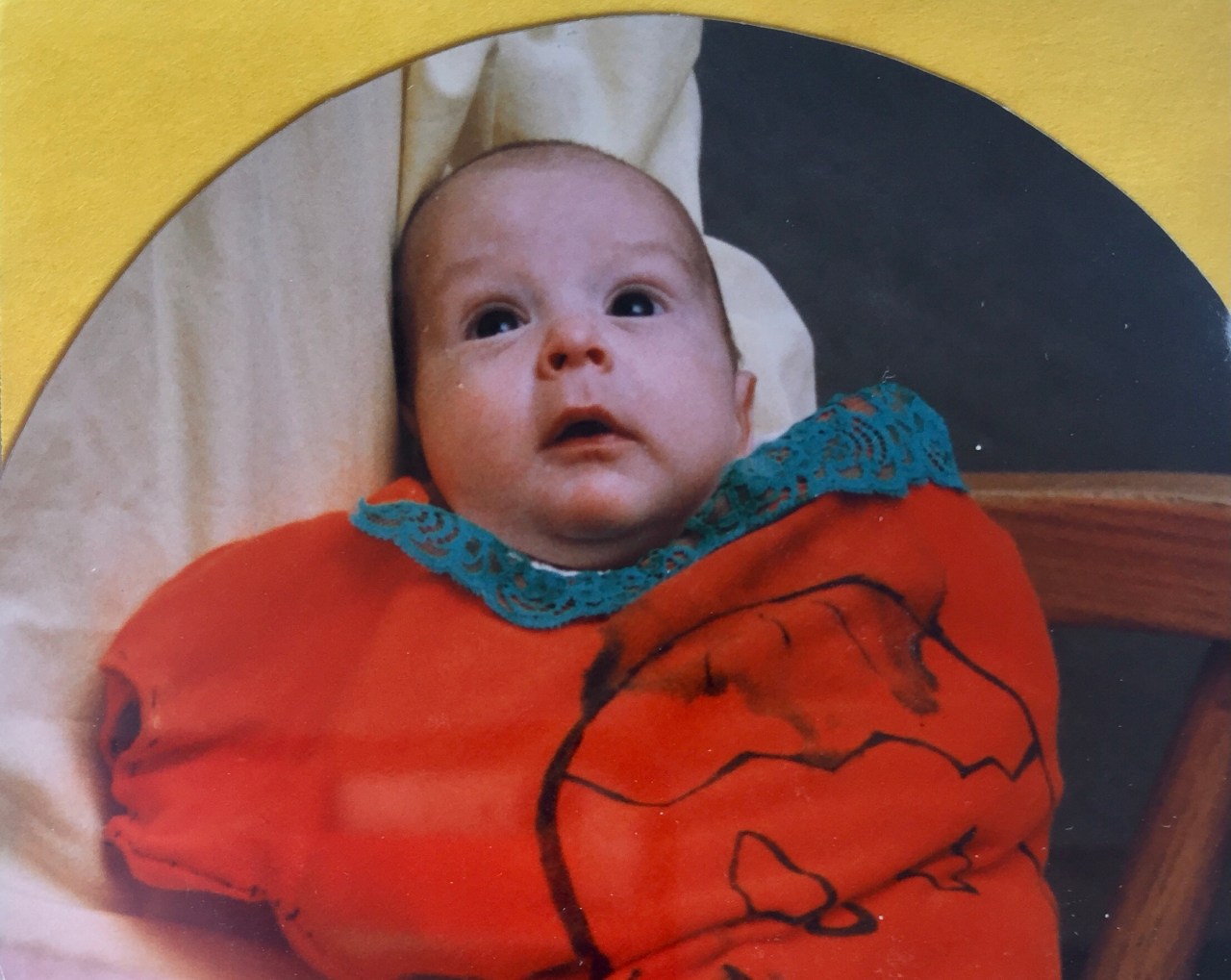
Once, when I was 7-years-old and my brother Evan was 4, my mom brought us to the cemetery on Halloween.
We had been driving by anyway, and so she considered it a good occasion to introduce us to the upcoming feasts of All Saints’ and All Souls’ Days even as our attention was fixated on costume-wearing and trick-or-treating later that evening.
My mom began, “This is the place where people are buried.”
“What?” my little brother asked incredulously. “You bury the person in the ground?”
My mom clarified, “The body is buried in the cemetery because you don’t need your body when you die because your soul goes to heaven to be with God. The body is like a costume.”
This is a throwback post to my Reflections on Rwanda Genocide Study Trip in May 2012
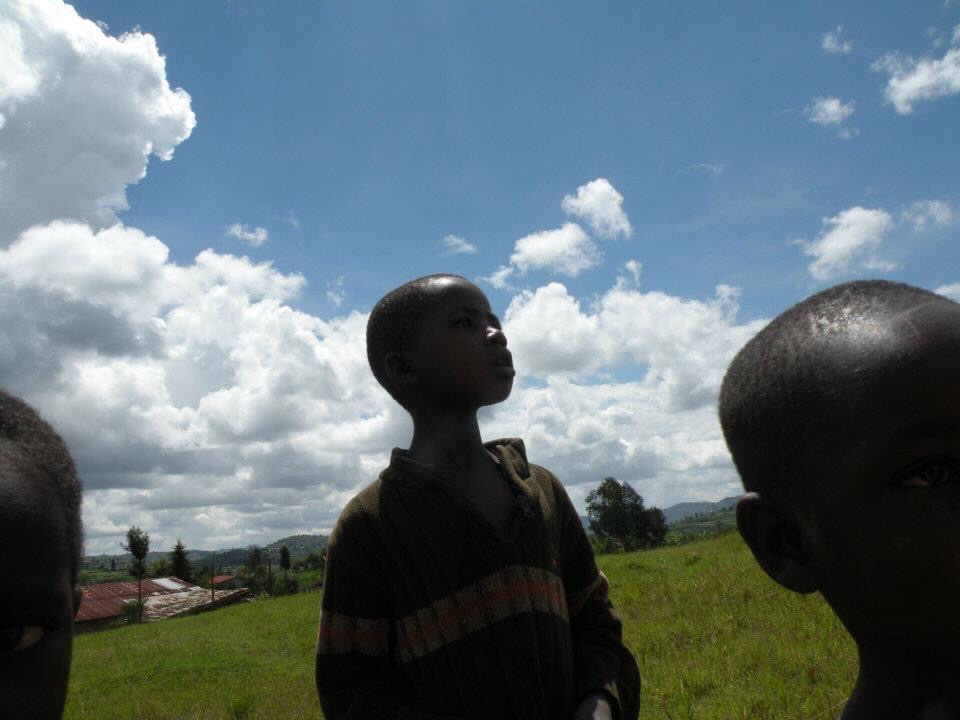
In May 2012, I travelled on the Reflections on Rwanda program, a two-week trip for Canadian students to visit the Republic of Rwanda and study the genocide that occurred there in 1994. The purpose for studying genocide is to gain insight into human nature through studying the extremes in human action. Listening to the stories of rescuers and survivors prompts me to study the virtues required to affirm the sanctity of human persons.
Confronting profound evil is a difficult experience that challenges my faith. We toured dozens of memorial sites throughout the country. Many of these sites were former churches where people had fled seeking refuge and peace. At each site, we saw hundreds of skulls and bones of victims. Looking at those skulls and bones, I thought about my own skull and my own bones. I thought about how these bones and skulls fall short of truly representing the victims. What the skulls and bones do emphasize is equality, but what they deemphasize is individuality. When I observed a display with rosaries and identity cards among the skulls, it made me think about the dynamism of the life that once animated those bodies that were so violently destroyed.
Today a friend of mine sent me a text with Ed Sheeran’s new-ish song “Visiting Hours” because, as she noted in her caption accompanying the video, it’s “On Mortality.”
I’ve listened to the song several times today, including watching the video of its premiere on the occasion of the state memorial for Michael Gudinski in whose memory Sheeran wrote the song in tribute.
In addition to being incredibly talented, there are other reasons why this song at this time is topping charts and resonating worldwide with the global population that has endured the pandemic – paradoxically, collectively and in isolation.
The first line begins, “I wish that Heaven had visiting hours…”
If there was any doubt that people could connect with such a paradisiacal lyric before the pandemic, the doubt has been resolved. The past two years, we have realized that we wish for our world to have visiting hours, too.
While we’re alive, we have a lot of workshops, education, and professional development on how to do things more strategically.
But, when is the last time you considered a strategy for how to die better?
The other day, I came across this great podcast episode by Dr. Yosefa (Fogel) Wruble onprecisely this.
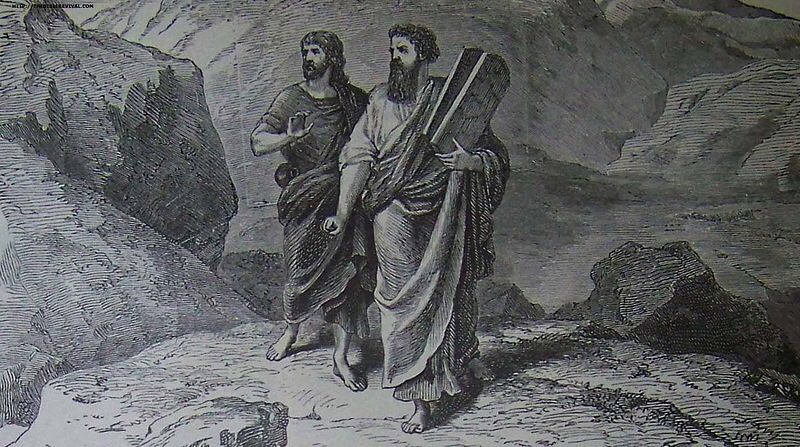
In it, she reflects on how Moses is an exemplar of dying well.
Here are three intriguing reasons she gives, which continue to be instructive and resonant today:
1) Appoint your successor
“One of the biggest gifts that a leader can give to his or her followers, to his or her community, is the clear – very clear – appointment of a successor. We know so many Hasidic sects and groups and different political parties and there’s so much history surrounding the lack of appointment of a successor and whenever I read the number of passages in which Joshua is appointed, it always makes my heart so happy because it’s one of the most basic lessons of leadership: When you’re a leader, learn how to delegate and when you’re done leading, when your time has come to a close, make sure that you find someone who can take your place and who can bring the institution or this group of people into their next era.”
Three years ago, on October 27, 2018, a white supremacist committed the deadliest attack on Jews in the United States, killing eleven worshippers at a Shabbat morning service in Pittsburgh.
That weekend, I was attending a Shabbaton [program of Jewish learning over the Sabbath] in Thornhill. Since I was staying with an Orthodox family, I did not use my phone during Shabbat. And so, like many in the Jewish community, I found out about the shooting once Shabbat ended.
My heart sank. I read a few articles before heading upstairs and I wasn’t going to mention the news to my hosts until they had seen it for themselves.
That weekend, I had experienced what it is to be guarded by the oasis of time that Shabbat had been for all of us. I recalled Heschel’s words: “The Sabbath is no time for personal anxiety or care, for any activity that might dampen the spirit of joy. The Sabbath is no time to remember sins, to confess, to repent or even to pray for relief or anything we might need. It is a day for praise, not for petitions.” How could we have avoided anxiety and petitions on that day had we not been observing Shabbat?
The other day, I learned about this interesting section in the Mishneh Torah (Hilkhot Gifts to the Poor 7:3) concerning charity which says:
One is commanded to give to a poor person according to what he lacks. If he has no clothes, they clothe him. If he has no utensils for a house, they buy [them] for him. If he does not have a wife, they arrange a marriage for him. If [the poor person] is a woman, they arrange a husband for marriage for her. Even if it was the custom of [a person who was rich but is now] a poor person to ride on a horse with a servant running in front of him, and this is a person who fell from his station, they buy him a horse to ride upon and a servant to run in front of him, as it is said, (Deut. 15:8) Sufficient for whatever he needs. You are commanded to fill whatever he lacks, but you are not commanded to make him wealthy.
My professor, in remarking upon this passage, noted the two-fold dimensions to charity being discussed here.
First, there is the idea that giving charity involves restoring the person in need to their proper dignity.
Secondly, and perhaps more beautifully, there is the implicit virtue that this demands of showing real attentiveness to the person.
In order to perceive that a person is lacking in some respect, it is necessary to be familiar with their ordinary standard of living.
I am obsessed with the stories of noble lives and acts of heroism.
In particular, I have been very focused on stories of heroism during the Second World War, particularly in the context of the Holocaust.
I cannot imagine my sustained engagement with the history of the Holocaust if not for the stories of the Righteous Among the Nations, who risked their lives to save Jews, as well as many other stories of courage and martyrdom.
These lights illuminate the darkness, clarify it and, to some modest extent possible, dispel it.
What I have begun thinking about more recently is how many stories of heroism are unknown to us and can never be known.
The stories that we have are a sliver of the humanity that persisted in the most dehumanizing of contexts.
Yet, there are surely many more stories that were snuffed out before they could edify successive generations.
The stories that we do know can help us exercise our imagination about what might have constituted noble and courageous responses in dire circumstances.
Can we let ourselves also be fortified by the confidence that there were also many anonymous heroes?
The facts of their righteousness may be known only to God, but the confidence that they existed can be known to us in hope.
Anyone who has ever loved someone who experienced profound vulnerability and dependency knows that people have dignity not only for what they can do but simply, and fundamentally, for who they are.
“Quality of life” is not an individual assessment but a community’s responsibility.
I recently came across these words of Rabbi Dr. Yitzchok Breitowitz who says:
The concept of quality of life, per se, is not a relevant idea because any life is worthy of sustaining because there are purposes for a soul to be in the body that we don’t always perceive. Sometimes the purpose of a soul in the body is not because of what the body can do – even if it’s comatose – but the body enables other people to do mitzvos [good deeds] such as pray, give charity, and the like. So sometimes, the purpose of your life is not what you yourself are accomplishing; the purpose of your life is what you are enabling others to accomplish, and that is a great spiritual benefit that will serve this soul well when it goes into the world of truth.
Such a view requires cultivating the ability to receive help, support, treatment, affection, and acts of kindness from others.
Kindness depends on cooperation between the recipient and the giver, between the person in need and the person rendering some form of service.
A seeming “diminishing quality of life” corresponds to increasing need and opportunities to show kindness.
Painting: Visiting the Sick, Modernist Israeli Oil Painting, Avraham Ofek




 DYING TO MEET YOU